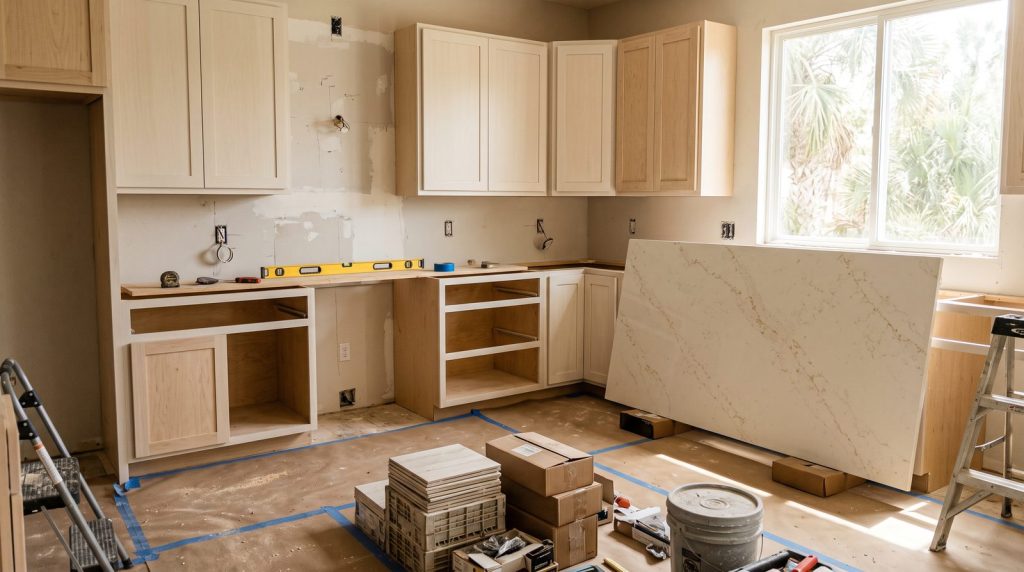
Ask three contractors what a kitchen remodel costs and you will get three numbers that are not comparable, because they are quietly pricing three different projects. One assumed you keep the layout. One assumed new cabinets. One assumed the plumbing moves. The spread between those is most of the budget.
Here is what the work actually costs in the Valley, where the money goes, and how to read two quotes side by side without guessing.
The price bands
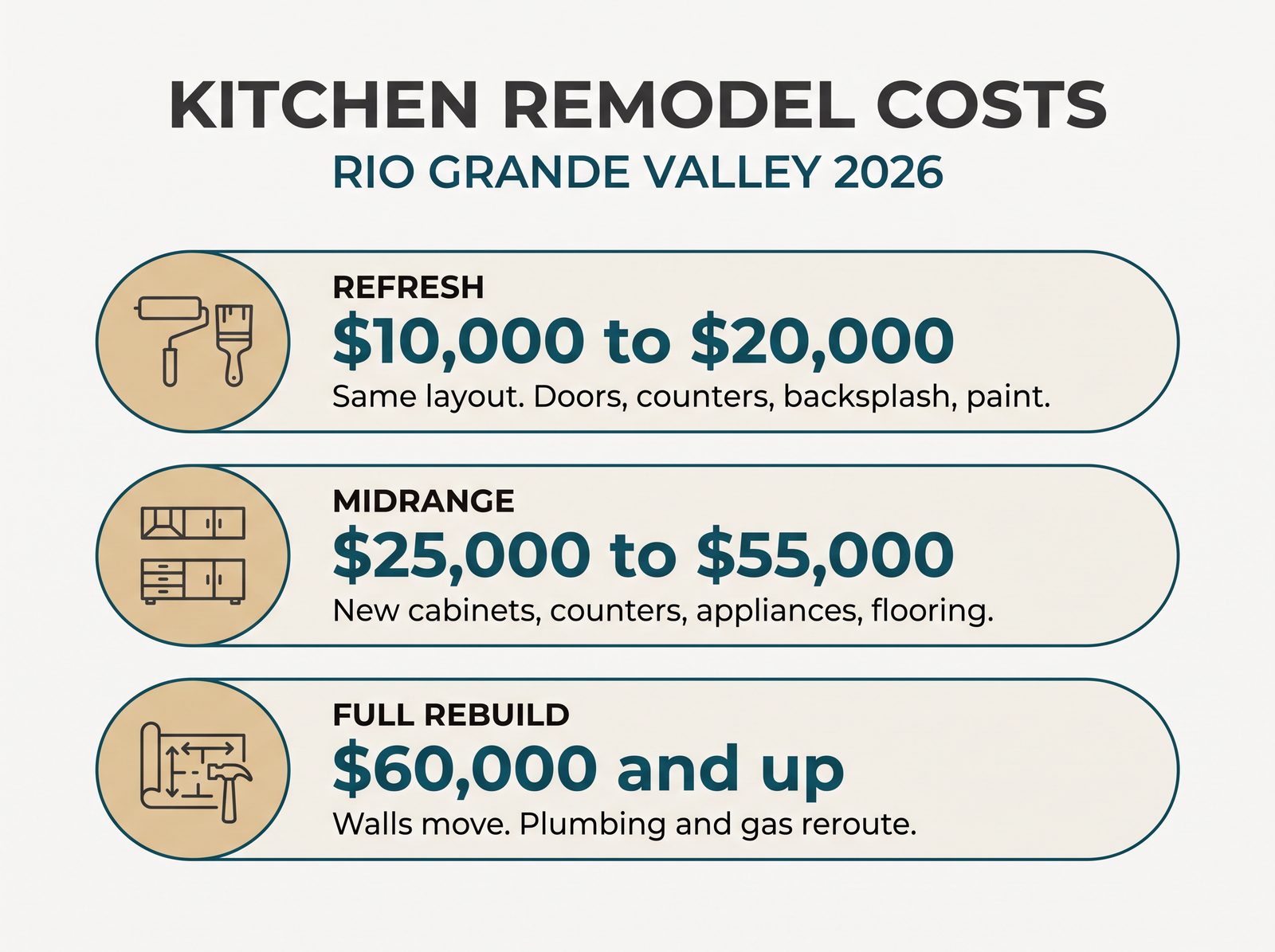
Texas kitchen projects commonly run between $13,800 and $69,000, and most midrange remodels land somewhere around $25,000 to $55,000. Construction costs in Texas run below the national average, and the Valley sits at the affordable end of Texas, so the same kitchen generally costs less here than in Austin or Dallas.
It helps to think in three tiers rather than one average.
- A refresh, roughly $10,000 to $20,000. Same layout, same cabinet boxes. Doors and hardware, new countertops, sink and faucet, backsplash, paint, maybe appliances. Nothing structural, no plumbing moves. This is the best value in remodeling and most people underestimate how different it looks.
- A midrange remodel, roughly $25,000 to $55,000. New cabinets, new counters, new appliances, flooring, lighting and electrical work to current code. Layout mostly stays put, though a sink or range might shift a short distance.
- A full rebuild, $60,000 and up. Walls move, the layout changes, plumbing and gas get rerouted, possibly a window or an island with services in it. Custom cabinetry pushes this further.
The jump between tier two and tier three is not finishes. It is whether anything moves.
Where the money actually goes
In most kitchens the order is predictable. Cabinets are the single largest line, often a third of the budget or more. Countertops come next, then appliances, then labor for demolition, installation, electrical and plumbing, then flooring, lighting, backsplash and paint.
That order matters because it tells you where to spend and where to save. Cutting $2,000 from the backsplash and lighting changes very little. Choosing stock cabinets over custom, or keeping the existing boxes and replacing the doors, changes thousands.
Three decisions do most of the damage to a budget:
- Moving the sink or the range. Drain lines, vents and gas lines are not where they are by accident. Moving them means opening floors or walls and bringing that work up to current code.
- Custom cabinetry. Beautiful, and frequently double what a good semi custom line costs for a difference most visitors never notice.
- Taking a wall out. Fine if it is not holding anything up. If it is, you are adding a beam, engineering and a permit.
What goes wrong behind the walls
Every remodel has at least one surprise, and in Valley houses they cluster.
Older kitchens here often turn up plumbing that was patched rather than replaced, and in our hard water that means scaled, narrowed supply lines. Electrical is the other common one: kitchens built before modern code rarely have the circuits a current kitchen needs, so adding dedicated circuits and ground fault protection appears mid project. Under the flooring, failed subfloor around a long leaking dishwasher is routine.
None of these are disasters. What matters is agreeing in advance how they get priced. Ask directly: if you open the wall and find something, what happens to the schedule and the number? A contractor who has a clear answer has done this before.
How to compare two quotes properly
Lay them side by side and look for what is missing rather than at the totals.
- Demolition and haul off. Included, or are you renting a dumpster?
- Allowances. If the quote says a figure for countertops, ask what material that actually buys. An allowance set too low makes a quote look competitive and ends as a change order.
- Cabinet line and construction. Plywood or particle board boxes, soft close or not, and which brand and series.
- Appliances. Supplied by whom, and installed by whom.
- Electrical and plumbing. Named as line items, or vaguely implied.
- Permits. Who pulls them, and is the fee inside the price.
- Countertop templating and fabrication. Usually a separate vendor with its own lead time.
- Paint and finish carpentry. Baseboards and trim often get left out and noticed at the end.
Two quotes with a $9,000 gap often turn out to be the same project once you add back what the cheaper one left out. Sometimes the cheaper one is genuinely cheaper. You only know after this exercise.
Payment, schedule and living through it
Tie payments to completed milestones rather than dates: a deposit, then demolition complete, cabinets set, counters installed, final on punch list completion. Dates slip for reasons nobody controls, and a payment schedule tied to the calendar rewards nobody for finishing.
Expect a midrange kitchen to take several weeks once work starts, with the long pole usually being cabinets and countertops rather than labor. Counters cannot be templated until the cabinets are set, and fabrication takes its own week or two afterward. That gap is normal and worth planning around.
Practical things people wish they had asked: what hours the crew works, whether the water will be off and when, where the refrigerator lives during the work, and whether there is a plan for dust, since kitchen demolition finds its way into the whole house.
The sequence, and why the kitchen sits empty for a week
Remodels run in an order that cannot be shuffled, and knowing it explains most of the waiting.
- Demolition. Fast and loud, usually a day or two.
- Rough work. Any plumbing, gas or electrical that moves happens now, while the walls are open. This is where surprises surface.
- Inspection, if the work was permitted. The job pauses until it passes.
- Close the walls, then drywall repair, texture and paint.
- Flooring, depending on whether it runs under the cabinets.
- Cabinets set. The moment the kitchen starts looking like a kitchen again.
- Countertop templating. A fabricator measures the installed cabinets, then cuts to that template. This is the gap people do not expect, often a week or two with no visible progress.
- Counters, sink, backsplash, appliances, trim, punch list.
Counters cannot be templated from drawings, only from cabinets that are physically in place, which is why the dead week lands near the end rather than the beginning. Plan to cook elsewhere through it, and put the refrigerator somewhere you can live with.
What is worth doing yourself
Sweat equity helps most where the task is slow rather than skilled.
Worth doing yourself: emptying and demolishing cabinets, removing old flooring, painting walls after the dust settles, sourcing your own appliances and fixtures, and the endless job of selecting finishes so the project is not waiting on you.
Worth paying for: anything touching gas, anything that needs a permit, cabinet installation, which is a leveling job that shows every millimeter of error across a run, and countertop work, which no fabricator will warranty if somebody else measured.
The in between case is tile. A patient, careful person does a decent backsplash over a weekend. A rushed one produces lippage and crooked grout lines at eye level in the most looked at room in the house.
One caution on demolition: it is the easiest task to take on and the easiest way to create a problem, because the person swinging the hammer is the one who finds the water line nobody mapped. If you demo yourself, know where the shutoffs are first.
What actually returns value
If part of your reason for remodeling is resale, the pattern is consistent. Midrange kitchen remodels return more of their cost than high end ones, because buyers notice that a kitchen is updated more than they notice that it is expensive.
Layout and function sell. Quartz against granite, or a pot filler, mostly does not. If you are staying ten years, buy what you want. If you are selling in two, spend in the middle of the market for the neighborhood and stop there.
Questions worth asking before you sign
- What exactly is in the written scope, including demolition and haul off?
- What do the allowances cover, and what happens if I choose above them?
- Which cabinet line, and what are the boxes made of?
- How are change orders priced, and who has to approve one?
- Who pulls the permit?
- How many other jobs are you running at the same time?
- Who is my day to day contact?
- What is the warranty on the workmanship, and how long?
Texas does not license remodeling contractors, so the contract and the references are what protect you. Ask for two recent kitchens you can go and look at, and call those homeowners. Ten minutes on the phone with somebody who lived through it tells you more than any review.
Finding a remodeler here
We keep short lists of remodeling contractors by city, built from their own listings rather than advertising: McAllen, Mission, Brownsville and Los Fresnos. The full directory is on the remodeling contractors page, and our other guides cover costs across the rest of the house.
If you would rather describe the kitchen once and let quotes come to you, tell us what you are planning and we will pass it to remodelers covering your city. Free, no obligation, and you choose who gets the job.
