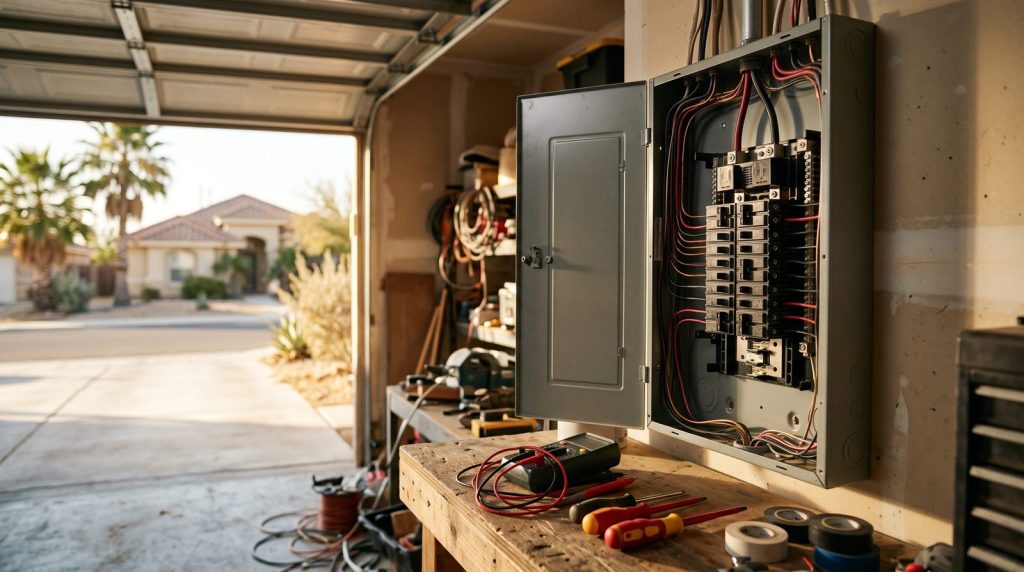
A plain guide for homeowners in McAllen, Edinburg, Pharr and San Juan: what the work costs, how to read a quote, and how to check a Texas electrical license before anybody opens your panel.
Almost every call to an electrician in the Valley starts in one of three places. Something stopped working. Something needs adding, usually an air conditioner, a pool pump, a car charger or a generator. Or an inspection turned up a problem a week before closing. The price conversation is different in each case, and so is the urgency.
Here is what the work actually costs here, how to tell when your panel is the thing holding you back, and how to check that the person quoting is licensed to do it.
- Service call during business hours: $75 to $150, often including the first hour
- Hourly labor for licensed residential work: $60 to $130, materials on top
- After hours and weekends: commonly $100 to $200 an hour
- Panel replacement or upgrade: $1,500 to $3,800 depending on amperage and permit
- Adding a dedicated circuit: a few hundred dollars if the panel has space
- Texas licenses electricians through TDLR, and the license is public, so verify it
What it costs, job by job
Three numbers cover most residential work: the service call to get somebody out, the hourly rate once they are there, and the price of the one big job that eventually comes for every house, which is the panel.
| Job | Typical cost | What moves the price | Urgency |
|---|---|---|---|
| Service callBusiness hours, often covers the first hour | $75 to $150 | Whether it is credited toward the repair | Scheduled |
| Hourly laborLicensed residential work | $60 to $130 | Access, and whether the panel has space | Scheduled |
| After hours callEvenings, weekends, holidays | $100 to $200 per hour | Time of day more than the work itself | Emergency |
| Add a dedicated circuitWindow unit, freezer, car charger | A few hundred dollars | Panel space and length of the run | Planned |
| Panel upgradeCommonly 100 to 200 amp | $1,500 to $3,800 | Amperage, permit, and what the utility requires | Plan ahead |
Figures are 2026 Texas ranges for licensed residential work. Always confirm whether the service call fee is credited toward the repair, because many companies credit it and some do not.
The hidden scheduler: Once the utility has to disconnect and reconnect at the meter, the job picks up scheduling and inspection steps that have nothing to do with how fast the electrician works. Ask about that timeline before you book the week off.
When the panel is the real problem
A lot of Valley houses are running loads their panels were never sized for. The original build assumed one air conditioning system and a modest kitchen. Since then the house has gained a bigger AC, maybe a second one, a pool pump, a spa, a shop compressor in the garage, a tankless water heater or a car charger. The panel has not changed.
The signs are consistent: a breaker that trips repeatedly, especially on hot afternoons when the air conditioning works hardest; lights that dim when the compressor or pool pump starts; a panel that is physically full or has breakers doubled up to make room; warmth or a burning smell at the panel; or a fuse box rather than breakers.
A breaker that trips is doing its job. Resetting it over and over is not a fix, it is ignoring a message. Sometimes the answer is moving one heavy appliance onto its own circuit, which is a cheap afternoon. Sometimes it is the panel itself.
Stop reading and call: A breaker that is warm to the touch, scorch marks around an outlet, or a burning smell near the panel is not a wait and see item. Turn the circuit off if you can do it safely and call somebody now.
What this looks like in real houses
A family adds a mini split for a converted garage. The electrician opens the panel and finds no space and two sets of doubled breakers already in place. The new circuit cannot go in until the panel is replaced.
A homeowner resets the same breaker all summer for three years. The cause turns out to be a shared circuit feeding a window unit and a freezer, with a connection in a hot attic that had loosened and started to cook.
A seller had a panel replaced years earlier by somebody working without a permit. The buyer’s inspector notices that the panel does not match the city records, and the sale stalls while it gets inspected and corrected.
What the heat does to an electrical system
Electrical work ages differently here, and two things drive it. The first is attic temperature. A Valley attic sits well above a hundred degrees for months, and much of the wiring, junction boxes and air conditioning disconnects live up there. Heat is hard on wire insulation and harder on connections that were never torqued properly. If an electrician says a connection in the attic has cooked, that is a real finding rather than an upsell.
The second is runtime. Air conditioning here runs most of the year, so the circuits feeding condensers and air handlers do far more work than the same circuits elsewhere. That is why those circuits are usually the first to reveal a panel sized for a smaller house.
Outdoors, humidity and salt air closer to the coast corrode disconnects, weatherheads and outdoor receptacles faster than you would expect. An outdoor outlet that trips its ground fault protection after every rain is telling you something.
The license, and how to check it in two minutes
Electrical is one of the trades Texas actually licenses. The Department of Licensing and Regulation issues electrical licenses and the record is public, so verifying is quick and free. An apprentice is learning and must be supervised. A journeyman is qualified to do the work. A master can pull permits and carries responsibility for the company’s work. The electrical contractor license belongs to the business and must have a master attached to it.
Ask for the number, ask whose name it is in, and look it up. Ask for proof of liability insurance too: the license says they are qualified, the insurance is what covers you if something goes wrong in your house.
A local quirk worth knowing: Search any directory for electricians in the Valley and the results mix three different businesses: licensed electricians, automotive electric shops that rebuild alternators, and general handymen who list electrical among a dozen services. They are not interchangeable, and only the first can pull your permit. We separate them on our own lists for exactly that reason.
What to check before you call
A few minutes of looking can save you a service call fee. Check whether the breaker has actually tripped, since a tripped breaker often sits between on and off: push it fully off, then firmly on. Press the reset button on nearby ground fault outlets, because one tripped outlet in a bathroom or garage can kill power to several others including outside. Work out whether the problem is one outlet, one room or the whole house, since that single answer changes what the electrician brings. If the whole house is dark, check whether the neighbors are too before paying anyone to tell you the utility is at fault. And write down when it started and what else was running, because intermittent faults are diagnosed from patterns.
Common Questions
Your electrical checklist
Useful Resources
- Texas Department of Licensing and Regulation Verify an electrician’s license before any work starts, free and public
- Best electricians in McAllen Our short list, screened so auto electric shops and handymen do not appear
- Best electricians in Edinburg Local companies first, then the nearby ones that cover the city
- Every electrician we list The full directory with ratings and service areas
- All our guides Costs and hiring advice across every trade in the Valley
Electrical is the trade where the license genuinely means something, the permit genuinely protects you, and the cheap quote is most often cheap because something has been left out of it. Ask for the number, ask who pulls the permit, and get the warranty in writing. Everything else is detail.
If you would rather describe the job once and let the quotes come to you, tell us what you need and we will pass it to electricians covering your city. Free, no obligation, and you still choose who gets the work.
