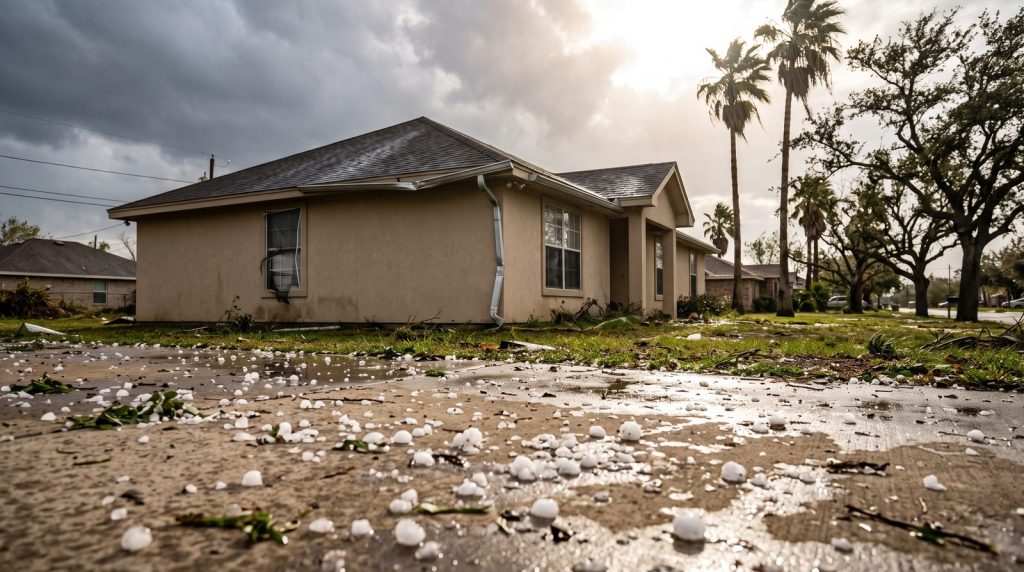
The day after a hailstorm moves through Hidalgo or Cameron County, two things happen. Your phone starts ringing, and strangers start knocking on your door offering free roof inspections. Some of them are good local companies doing exactly what they should be doing. Some of them will be in another state by the time your roof leaks.
This is the part nobody explains before you need it: what insurance actually covers, what gets denied, and which decisions in the first week determine whether you end up with a new roof or a denied claim on your record.
First, is it actually hail damage?
Insurance covers sudden damage from a covered event. It does not cover a roof that wore out. That single distinction decides most claims, so it is worth understanding what an adjuster is looking for.
Hail damage on asphalt shingles usually looks like dark bruises where the granules have been knocked away, often round and random rather than in lines. Press one and it can feel soft, like the mat underneath has been crushed. What it is not is a neat row of worn patches, or granules in the gutter on their own, which is what an aging roof does anyway under this sun.
The quickest confirmation is collateral damage, and it is on the ground where you can see it:
- Dents in soft metal, especially gutters, downspouts, vents and flashing.
- Bent or flattened fins on the outdoor air conditioning unit.
- Torn window screens, dented garage doors, chipped paint on fascia.
- Splatter marks on a dusty patio, where hail cleaned small circles into the dirt.
If the soft metal around the house is untouched, a claim for hail damage on the roof is going to be a hard argument. If everything metal is dimpled, the roof probably took the same beating.
Document it before anyone climbs up
Photograph everything before a single contractor touches the roof. Wide shots of each elevation, close shots of the dents and screens, and a picture of any hail still on the ground with something for scale, a coin or your hand. Note the date and rough time of the storm.
That timestamp matters, because insurers match damage to a specific weather event. A claim that says the roof was damaged sometime this year is far weaker than one tied to the afternoon of a storm that the National Weather Service also recorded.
Keep receipts for anything you do to prevent further damage, such as a tarp. Policies generally require you to limit additional damage, and that spending is usually reimbursable.
Should you file at all?
Not every bit of damage is worth a claim, and this is where homeowners get hurt.
Start with the deductible. Many Texas policies carry a separate wind and hail deductible set as a percentage of the insured value rather than a flat dollar figure. One or two percent sounds small until you apply it: on a home insured at $250,000, a two percent deductible is $5,000 out of your pocket before the policy pays anything. If the repair is $4,000, filing achieves nothing except putting a claim on your record.
Then consider the history. A denied claim still appears in the claims database that insurers check at renewal. Filing a weak claim can cost you later even when it pays nothing now.
The sensible order is to have a local roofer inspect first and tell you honestly whether there is documentable storm damage. A roofer who says there is not is doing you a favor, even though it does not feel like one.
Replacement cost or actual cash value, and why it changes everything
Two policies that cost nearly the same can pay out very differently.
Replacement cost value pays what it costs to put a new roof on, minus your deductible. It usually arrives in two payments: an initial check for the depreciated value, then the rest, called recoverable depreciation, once the work is finished and you send proof. That final payment is the part people forget to claim.
Actual cash value subtracts depreciation and keeps it. On a roof that is fifteen years into a twenty year life, depreciation can be most of the money. Homeowners on these policies are often shocked by the first check, because they expected a new roof and received a fraction of one.
Read your declarations page before the adjuster arrives, so you know which one you have and what your wind and hail deductible actually is. Those two lines set your expectations more accurately than anything a contractor tells you at the door.
Your deductible is not optional, and this one is the law
At some point a roofer may offer to cover your deductible, eat it, work around it, or write the invoice so that it disappears. The pitch sounds generous. It is a crime in Texas, and it is one you participate in.
Since September 2019, Texas law has made it illegal for a contractor to waive, absorb or rebate an insurance deductible on property repairs. Violations are a Class B misdemeanor, carrying up to 180 days in county jail and a fine of up to $2,000. The law also requires that contracts of $1,000 or more that will be paid from insurance proceeds carry a clear written notice that you are responsible for paying your deductible.
Beyond the legal exposure, the offer tells you something practical. A company willing to build fraud into the first conversation is telling you how it handles the parts of the job you will not be watching.
The people who arrive with the storm
After a significant hail event, out of town crews work the neighborhoods. Not all of them are bad, but the pattern is predictable enough to screen for.
- They knock on your door rather than being called.
- The address on the paperwork is in another city or state, or there is no address at all.
- They want a signature today, often on something described as authorization to inspect.
- They ask for a large deposit before materials are ordered.
- Online reviews all appeared in the last few weeks.
Be especially careful with any document that assigns your insurance benefits to the contractor, or that commits you to use them if the claim is approved. Read what you sign on your own doorstep, or do not sign it there at all.
The practical defense is simple: get a second opinion from a company that was working in the Valley before the storm and will be here after it. Texas does not license roofers, so local track record, insurance certificates and a written workmanship warranty are what you have to go on.
How the claim actually runs
Once you file, an adjuster inspects and writes a scope of what they believe the repair involves and what it should cost. Your roofer should meet the adjuster on site if possible. Not to argue, but because two people looking at the same roof catch more than one, and the scope is easier to correct while everyone is standing on it.
Compare the adjuster’s scope with your roofer’s estimate line by line. Missing items are normal rather than sinister: ridge vents, drip edge, flashing, a second layer nobody knew about, code required upgrades. Those become a supplement, which is a request for the insurer to revise the scope with documentation attached. An experienced local roofer handles supplements routinely.
If the claim is denied or the money is clearly short, you have options before hiring anyone. Ask for a reinspection, in writing. Look up the appraisal clause in your policy, which lets each side appoint an appraiser to settle the amount of loss. Public adjusters, who work for you rather than the insurer, are licensed by the Texas Department of Insurance, so verify any you consider. And the Department takes complaints about how an insurer handled a claim.
A sensible order of operations
- Photograph the damage, including the soft metal and screens, and note the storm date.
- Tarp anything actively leaking and keep the receipt.
- Have a local roofer inspect and tell you whether there is a documentable claim.
- Read your declarations page for the wind and hail deductible and whether you have replacement cost or actual cash value.
- File if the damage clearly exceeds the deductible.
- Have the roofer meet the adjuster, then compare scope and estimate line by line.
- Sign a contract that names the work, the materials and the warranty, and that states you will pay your deductible.
- After completion, send the insurer proof so the recoverable depreciation is released.
Who to call in the Valley
We keep short lists of roofing companies by city, built from their own listings rather than from advertising, with several that handle storm damage and insurance work specifically: McAllen, Edinburg, Brownsville, Alamo and Weslaco. The full directory is on the roofing contractors page.
For what the work costs when you are paying out of pocket, read what a roof replacement costs in the Valley, and our other guides cover the rest of the house.
Or describe the damage once and let the quotes come to you: send us the job and we will pass it to roofers covering your city who are taking work.
