Your roof takes more punishment than any other part of your home. In the Rio Grande Valley, that means six straight months of temperatures above 90 degrees, humidity that rarely drops below 70 percent, and hurricane season running from June through November every single year. The roofing materials RGV homeowners choose don’t just affect how the house looks. They control how much heat gets inside, how hard your AC has to work, and how often you’ll be writing a check for repairs or a full replacement.
Here’s the deal. Not all roofing materials survive Valley conditions the same way. Some absorb heat like a sponge. Others reflect it. Some last 20 years. Others last 50 or more. And the price difference between the cheapest option and the smartest long term option might not be as big as you think once you factor in energy bills, maintenance, and replacement costs down the road.
This article breaks down the three most common roofing materials RGV homeowners choose — asphalt shingles, standing seam metal, and clay tile — and compares them on what actually matters: heat performance, lifespan, cost, and how they hold up in our climate.
Why Does Your Roof Material Matter So Much in the Rio Grande Valley?
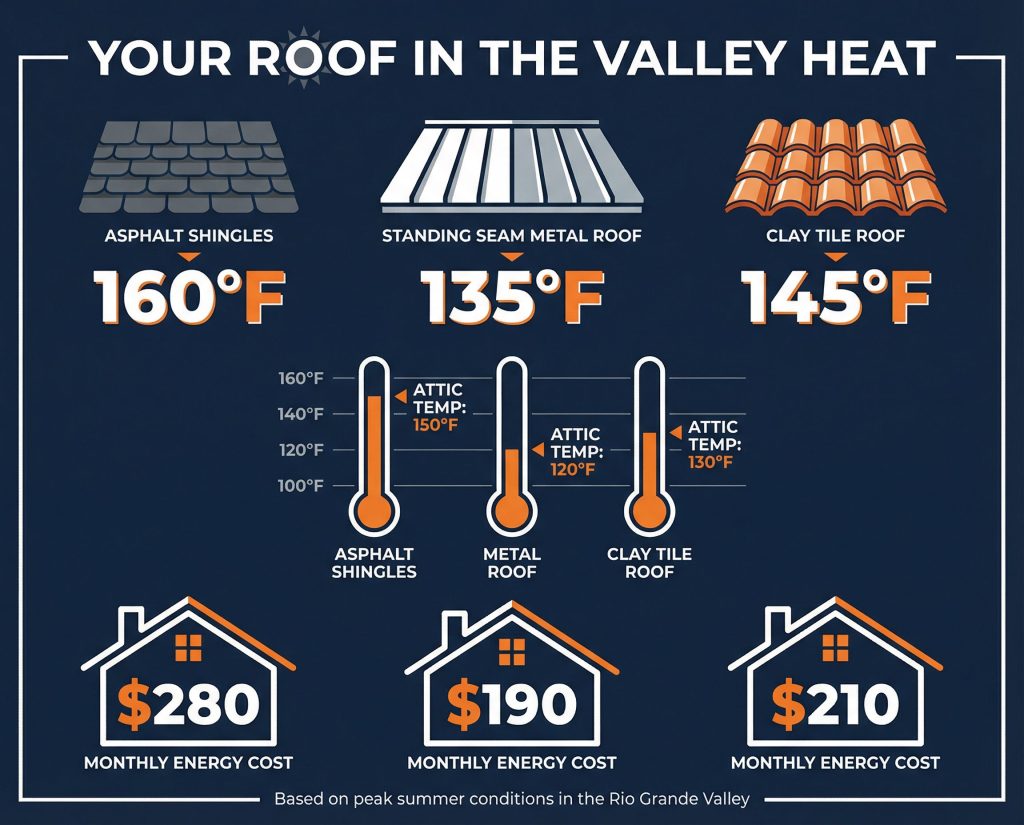
Most people think of the roof as something that keeps rain out. That’s true, but in the Valley, your roof’s biggest job is managing heat. On a summer afternoon when it’s 100 degrees outside, a standard dark asphalt shingle roof can hit surface temperatures of 150 to 170 degrees. That heat doesn’t just sit up there. It pushes down through your roof deck, into your attic, superheats your ductwork, and forces your air conditioning to run nonstop just to keep your house at 74.
According to the Department of Energy, reflective roofing can reduce cooling energy costs significantly in hot climates like ours. That matters because cooling makes up a massive chunk of your electric bill from April through October in the RGV. Choosing the wrong roofing material can cost you hundreds of extra dollars every summer. Choosing the right one can pay for itself over time.
Quick fact: A standard dark shingle roof can reach 150 to 170°F on a summer afternoon in the Valley. A coated metal roof under the same sun stays closer to 110 to 130°F. That 30 to 40 degree difference on the surface translates directly to a cooler attic, less strain on your AC, and lower electric bills every month.
How Do Asphalt Shingles Perform in Valley Heat?
Asphalt shingles are the most popular roofing material in the country, and the RGV is no exception. They are affordable, easy to install, and available at every supply house from Brownsville to McAllen. For homeowners on a tight budget, they make sense upfront. But there are real trade offs you need to understand before going this route.
Shingles are made from asphalt and fiberglass with a layer of protective granules on top. The problem in the Valley is that they absorb heat instead of reflecting it. A dark shingle roof can transfer enough heat into your attic to raise indoor temperatures by 20 to 25 degrees if your insulation isn’t doing its job. That puts enormous stress on your AC system during the months when you need it most.
Lifespan is the other concern. Most standard shingles are rated for 20 to 30 years, but in extreme heat climates like ours, that timeline gets compressed. The constant UV exposure and thermal cycling — expanding in the heat during the day, contracting at night — causes granule loss, curling, cracking, and premature aging. In practice, many Valley homeowners find themselves looking at a replacement closer to the 15 to 20 year mark.
On the cost side, asphalt shingles typically run between $3.50 and $7.50 per square foot installed in Texas. For a typical 2,000 square foot roof, that puts you in the $7,000 to $15,000 range. That’s the lowest upfront cost of the three options we’re comparing. But remember, you’ll likely need to replace that roof at least twice over the same period a metal or tile roof would still be going strong.
What Makes Metal Roofing the Best Long Term Investment in the RGV?
Metal roofing has exploded in popularity across South Texas, and for good reason. Standing seam metal panels with factory applied reflective coatings can reflect 50 to 70 percent of solar energy, compared to just 15 to 25 percent for standard shingles. That’s a massive difference in how much heat actually makes it into your home.
Industry data from the Metal Roofing Alliance shows that metal roofs can save homeowners between 10 and 40 percent on cooling energy costs, depending on the roof color, coating, and ventilation setup. In the Valley, where your AC runs six months out of the year, that translates to real savings — often $50 to $150 per month during peak summer. Over a decade, that adds up to thousands of dollars.
The durability factor is where metal really separates itself. A quality standing seam metal roof lasts 40 to 70 years with minimal maintenance. It doesn’t crack, curl, lose granules, or rot. It holds up against high winds — many systems are rated for 120 mph or higher — which matters when hurricane season rolls around. And because metal sheds heat quickly once the sun goes down, your house starts cooling faster in the evening than it would under shingles.
The upfront cost is higher. Standing seam metal runs between $9 and $16 per square foot installed in Texas. For that same 2,000 square foot roof, you’re looking at $18,000 to $32,000. That sticker price makes people hesitate. But when you factor in the energy savings, the longer lifespan, lower maintenance costs, and potential insurance discounts for wind and hail resistance, metal roofs almost always come out ahead over 30 years. Some homeowners also qualify for the federal Energy Efficient Home Improvement Credit, which covers 30 percent of material costs up to $1,200 for qualifying ENERGY STAR certified metal roofing.
Is Clay Tile Roofing Worth the Price in South Texas?
Clay tile is the classic roofing material you see on Spanish and Mediterranean style homes across South Texas. It looks beautiful, no question about it. And from a durability standpoint, clay tile is hard to beat. A properly installed clay tile roof can last 50 to 100 years or more. The tiles themselves are fireproof, insect proof, and resistant to rot.
Clay tile offers some energy efficiency benefits thanks to its thermal mass — the tiles absorb heat slowly during the day and release it slowly at night, rather than dumping all that heat into your attic at once like shingles do. The natural air gap created by the curved tile shape also allows some ventilation underneath, which helps. That said, clay tile doesn’t reflect heat as effectively as a coated metal roof. It’s better than shingles for managing heat transfer, but it’s not the best performer in the group.
The biggest drawback is cost and weight. Clay tile roofing runs between $12 and $25 per square foot installed, which means that same 2,000 square foot roof could cost $24,000 to $50,000. It’s also significantly heavier than metal or shingles, which means your home’s structure needs to be able to support the load. Older Valley homes may require reinforcement before clay tile can be installed, and that adds to the project cost.
Maintenance is another consideration. While the tiles last decades, the underlayment beneath them typically needs replacing every 20 to 30 years. Individual tiles can crack from impact — large hail, falling branches, or someone walking on the roof incorrectly. And repairs require a skilled installer who knows how to work with tile, which isn’t always easy to find at a fair price in the RGV.
How Do These Roofing Materials RGV Homeowners Use Actually Compare?
| Factor | Asphalt Shingles | Standing Seam Metal | Clay Tile |
|---|---|---|---|
| Cost Per Sq Ft (Installed) | $3.50 – $7.50 | $9 – $16 | $12 – $25 |
| Typical Total Cost (2,000 sq ft roof) | $7,000 – $15,000 | $18,000 – $32,000 | $24,000 – $50,000 |
| Lifespan | 15 – 25 years in Valley heat | 40 – 70 years Best | 50 – 100+ years |
| Peak Surface Temp | 150 – 170°F | 110 – 135°F (coated) Best | 130 – 150°F |
| Solar Reflectance | 15 – 25% | 50 – 70% Best | 25 – 40% |
| Energy Savings on Cooling | Baseline | 10 – 40% reduction Best | 10 – 20% reduction |
| Wind Resistance | Moderate (65 – 110 mph rated) | High (120+ mph rated) Best | High (can resist 150 mph) |
| Hail Resistance | Low to moderate | High (Class 4 available) | Moderate (can crack on impact) |
| Weight | Light (2 – 4 lbs per sq ft) | Light (1 – 2 lbs per sq ft) Best | Heavy (8 – 12 lbs per sq ft) |
| Maintenance | Moderate (inspect annually, replace damaged shingles) | Low (minimal upkeep needed) | Low tiles, but underlayment needs replacing every 20 – 30 years |
| Best For | Tight budgets, short term ownership | Long term savings, energy efficiency, storm protection | Aesthetics, historic or Spanish style homes |
How Much Can the Right Roof Save You Over 30 Years?
This is where it gets interesting. Let’s run the numbers for a typical Valley homeowner with a 2,000 square foot home.
With asphalt shingles, you’ll pay around $10,000 for the initial install. In 15 to 20 years, you’re replacing it again for another $10,000 to $12,000 (accounting for material price increases). That’s $20,000 to $22,000 in roofing costs over 30 years, plus higher monthly energy bills the entire time because shingles don’t reflect heat well.
With a standing seam metal roof, you’ll pay $20,000 to $25,000 upfront. But you won’t need a replacement for 40 to 70 years. Maintenance is minimal. And if you’re saving even $75 per month on cooling costs for six months of the year, that’s $450 per year — or $13,500 over 30 years. Add in potential insurance discounts and the federal tax credit for qualifying products, and the metal roof often costs less than the shingle roof over its lifetime. That’s not a theory. That’s math.
Clay tile falls somewhere in between on lifetime cost. The tiles last the longest of any option, but the upfront investment is the highest, the underlayment still needs replacing, and the energy savings aren’t as strong as metal. For homeowners who love the look and plan to stay in their home for decades, tile makes sense. For pure value, metal wins.
What Should You Look for When Choosing Roofing Materials in the RGV?
Regardless of which material you lean toward, there are a few things every Valley homeowner should consider before signing a contract.
First, check reflectivity ratings. Any roofing product worth considering in this climate should have an Energy Star rating or at least published solar reflectance and thermal emittance values. The Department of Energy’s cool roofs guide is a solid resource for understanding what those numbers mean and what to look for.
Second, make sure your contractor is licensed. You can verify any contractor’s license for free using the Texas Department of Licensing and Regulation license lookup tool. It takes 30 seconds and can save you from a world of problems.
Third, get at least three written estimates that break down materials, labor, tear off, and warranty details separately. If a contractor gives you one lump number and won’t break it down, that’s a red flag. You can learn more about what a proper roofing estimate should include from the National Association of Home Builders.
Finally, ask about wind and hail ratings. This is the RGV. Hurricane season is real. Impact resistant roofing rated Class 4 can help protect your home and may qualify you for insurance discounts. Ask your agent what credits are available before you choose your material.
So Which Roofing Material Is the Smartest Choice for Valley Homeowners?
When you look at the full picture — upfront cost, energy savings, lifespan, maintenance, storm resistance, and long term value — metal roofing comes out ahead for most RGV homeowners. The upfront price is higher than shingles, but the math works in your favor once you factor in the 40 to 70 year lifespan, the 10 to 40 percent reduction in cooling costs, the lower maintenance, and the insurance discounts. Over 30 years, you’re likely spending less total on a metal roof than you would on two or three rounds of asphalt shingles, and your house stays cooler the entire time. Clay tile is a beautiful, long lasting option for homeowners who prioritize aesthetics and plan to stay for the long haul, but the weight requirements and higher entry cost make it impractical for many Valley homes. Asphalt shingles still make sense for homeowners on a strict budget or those planning to sell within a few years, but they are not a long term solution in this climate. Whatever material you choose, get three written estimates, verify your contractor’s insurance, and make sure the product is rated for the heat and storms we deal with down here. That’s how you protect your biggest investment.
