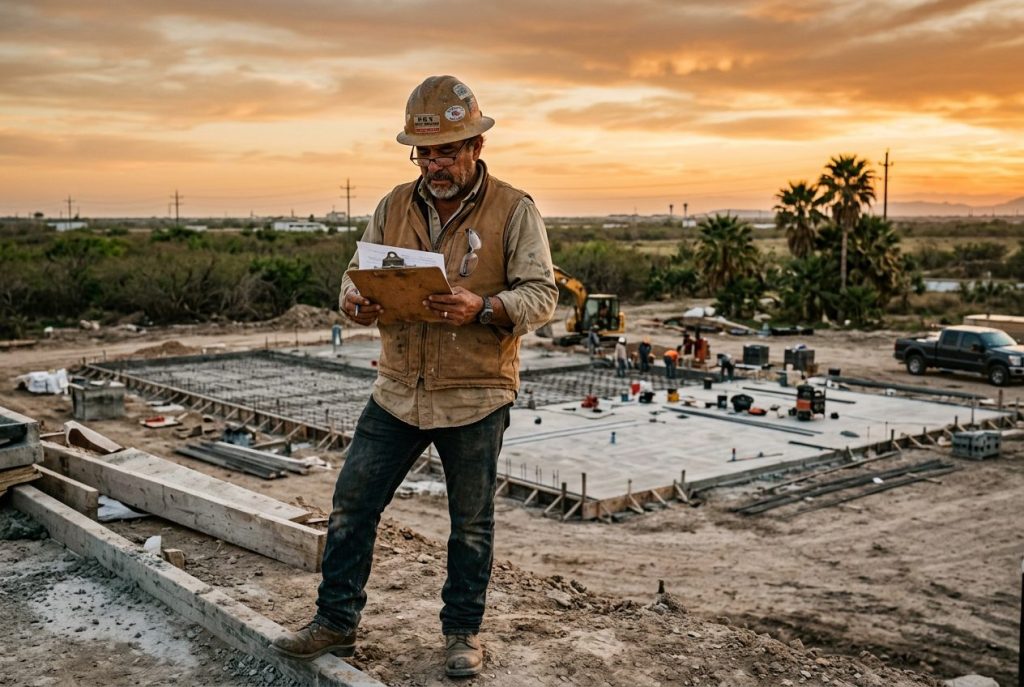
A field guide for electricians, plumbers, HVAC techs, roofers, and general contractors working from Brownsville to McAllen — because generic Texas policies miss what this market actually needs.
If you run a contracting business in the Rio Grande Valley, you already know this market operates differently than the rest of Texas. The permit office in McAllen is not the same as the one in Brownsville. The subs you bring onto a job might live twenty minutes across the border. Hurricane season runs from June through November, and South Texas sits right in its corridor. Every year, job sites from Harlingen to Edinburg face wind exposure and flooding that contractors in Dallas barely think about. And yet nearly every guide to contractor insurance in Texas talks to someone north of San Antonio, as if the lower Valley does not exist.
That is the gap this article closes. The contractors who get financially wiped out are not always the fly-by-night operators. Sometimes they are solid, experienced crews who had the wrong policy for this specific market. Before you pull your next permit anywhere from Mission to Pharr to Brownsville, here is what you actually need to know.
- General liability insurance — required to pull permits and bid commercial work in most RGV cities
- Workers compensation — optional for private work but mandatory on government and publicly funded projects
- Commercial auto insurance — required by Texas law for any vehicle used for business purposes
- Tools and equipment insurance (inland marine) — covers your tools wherever they go
- Builder’s risk insurance — protects active construction projects and materials on site
- Surety bonds — required for specific trades and municipalities across the Valley
How Does General Liability Insurance Protect an RGV Contractor?
General liability is the policy every contractor in Texas needs before anything else happens. It covers third party bodily injury and property damage — meaning if your crew causes damage to a client’s home or someone gets hurt on your job site, your GL policy is what responds. Without it, you cannot pull permits in most RGV cities, and you will not get on any approved vendor list for commercial or government work from McAllen to Edinburg.
The industry standard for contractor insurance in Texas is $1 million per occurrence with a $2 million aggregate limit. Most commercial clients and general contractors throughout the Valley require at least that before they hand you a contract. Government projects typically require the same or more.
Here is the piece that catches a lot of contractors off guard: your general liability policy needs to include Products and Completed Operations coverage. If you finish a job today and a problem shows up six months from now, standard GL without this endorsement will not cover it. Electrical work, plumbing installs, HVAC systems — completed operations claims are real, and this is the only coverage that pays out after the job is done and you have left the site. Do not let an agent sell you a bare bones GL policy without asking about this endorsement specifically.
Why Is Workers Compensation Such a Big Deal in Texas?
Texas is the only state in the country where most private employers can legally opt out of workers compensation. The state calls contractors who skip it “nonsubscribers,” and plenty of operators down here take that option to save money. Here is why that is almost always a mistake.
When you carry workers comp, you receive what is called statutory immunity. If one of your employees gets hurt on the job, they go through the workers comp system to recover medical bills and lost wages. They cannot sue you for pain and suffering in civil court. Without workers comp, an injured worker takes you to civil court with essentially no cap on damages. A single trench collapse, a fall from a scaffold, a heat injury on a summer job site in Weslaco in July — any of those can become a $200,000 lawsuit or more if you are a nonsubscriber. According to industry data, judgments in these cases routinely exceed that amount.
Workers comp is also mandatory the moment you work on any government or publicly funded project, whether that is a city contract in Pharr, a school construction job in Mission, or anything involving state or federal dollars. And the practical reality in the RGV is this: most reputable general contractors require their subcontractors to carry it regardless of what state law says. Skip it and you are losing work.
Solo operators, pay attention: If you work alone with no employees but still need to show proof of workers comp to land a contract, ask your agent about a workers comp ghost policy. This is a legitimate policy that generates a valid Certificate of Insurance even with no employees on payroll. It lets individual tradespeople satisfy COI requirements without paying full workforce premiums — and it is a tool that a lot of Valley solo operators do not know about.
The cost of workers comp for construction workers in Texas averages around $1.89 per $100 of payroll, according to industry data. A contractor carrying $500,000 in annual payroll might pay somewhere between $9,000 and $15,000 per year, depending on their trade classification and safety record. A clean record and a documented safety program can bring that number down meaningfully.
What About Builder’s Risk, Tools Insurance, and Commercial Auto?
General liability and workers comp are the two biggest conversations, but three other coverages keep RGV contractors out of trouble regularly.
Builder’s risk insurance, sometimes called course of construction coverage, protects the structure itself and materials on an active job site. In South Texas this is not a nice-to-have. Hurricane season runs from June through November, and any active project during those months faces real wind and flooding exposure. If a tropical system tears through a framing job in Harlingen before the roof goes on, a builder’s risk policy is what covers your materials and your progress. Owners and lenders typically require this coverage for any new construction or major renovation. After Hurricane Beryl in 2024 generated between $2.5 billion and $4.5 billion in insured losses across Texas, according to Moody’s Risk Management Solutions, the conversation about storm coverage for active job sites got a lot more serious across the state.
Tools and equipment coverage, also called an inland marine or tool floater policy, covers your tools wherever they go — the truck, the site, the warehouse. A standard GL policy does not cover stolen equipment. In the RGV, where job site theft at remote colonias project locations can mean overnight vulnerability, this coverage is practical protection. A quality tool set for a skilled tradesperson can easily reach $10,000 or more in replacement cost.
Commercial auto insurance is required under Texas law for any vehicle used for business purposes. Your personal auto policy will not cover an accident that happens while you are hauling materials or driving employees to a site. Your personal insurer can deny the claim outright. Aim for at least $1 million in liability limits on your work vehicles, especially if you run heavy trucks.
What Are the License-Specific Insurance Requirements in Texas?
Here is where things get trade specific, and where a lot of Valley contractors run into trouble. Texas does not require a statewide general contractor license — but specialty trades are a different story entirely.
The Texas Department of Licensing and Regulation governs electricians, HVAC contractors, and several other trades. The Texas State Board of Plumbing Examiners governs licensed plumbers. Both agencies require you to maintain minimum insurance limits at all times while your license is active. Let your coverage lapse even for a single day and you risk your license going inactive until you can prove reinstatement of coverage. For a working contractor, that is a real problem.
These are state minimums. Commercial clients and general contractors across the RGV typically require $1 million per occurrence regardless of what the state requires. Always review the contract requirements, not just the state floor.
| License / Trade | Regulatory Body | Min. Per Occurrence | Min. Aggregate | Completed Ops Required |
|---|---|---|---|---|
| General ContractorNo statewide license | Municipality | $1M (industry standard) | $2M (industry standard) | Strongly recommended |
| Electrician | TDLR | $300,000 | $600,000 | $300,000 aggregate |
| HVAC Contractor — Class AAny size system | TDLR | $300,000 | $600,000 | $300,000 aggregate |
| HVAC Contractor — Class BSystems under 25 tons | TDLR | $100,000 | $200,000 | $100,000 aggregate |
| Plumbing Contractor | TSBPE | $300,000 | Not specified | Not specified |
Sources: Texas Department of Licensing and Regulation (tdlr.texas.gov) and Texas State Board of Plumbing Examiners (tsbpe.texas.gov). State minimums are the legal floor — most commercial contracts in the RGV require $1M per occurrence regardless of trade.
What Do Subcontractors Need to Carry and Why Does It Matter in the RGV?
This is one area where the RGV market is genuinely different, and it matters more here than most people realize. When you run as a general contractor in this market, you are often coordinating subcontractors who run lean operations, sometimes one or two people, sometimes more. Some are licensed and fully covered. Some are not. If one of their workers gets hurt on your site and your sub does not have proper coverage, that liability can flow directly to you.
Here is the standard you need to hold every sub to before they set foot on your job: they carry their own general liability, their own workers comp, and they name you as an additional insured on their policy. The additional insured endorsement extends their coverage to protect you if a claim arises from their work. Without it, a sub’s accident on your project becomes your problem.
The tool for managing this is the Certificate of Insurance, or COI. Before any sub starts work, you get their COI. You verify the coverage dates, the limits, your name as additional insured, and the carrier. A COI that is expired, has inadequate limits, or does not name you as additional insured is the same as having nothing. I have seen experienced Valley contractors lose serious money because they hired a sub who showed a COI but the coverage had lapsed the week before the job started. Check the expiration date. Every time.
Do not assume the GC’s policy covers your crew. If you are working as a sub, your work and your employees are generally not covered by the general contractor’s insurance. You need your own policy. This is one of the most common and costly assumptions in this market.
What Does Contractor Insurance in Texas Actually Cost?
Let me give you real numbers, because “it depends” is not useful when you are trying to budget for the year. The cost of contractor insurance in Texas depends primarily on what trade you are in, how much payroll you carry, your claims history, and what coverage limits you need. The figures below are based on current industry data for Texas contractors and assume standard coverage limits.
| Trade | GL Only (Annual) | Full Package Estimate GL + Workers Comp + Commercial Auto |
Risk Level |
|---|---|---|---|
| General Contractor | $1,200 to $3,500 | $6,000 to $25,000 | Moderate |
| Electrician | $1,000 to $2,500 | $10,000 to $30,000 | Moderate High |
| Plumber | $900 to $2,200 | $10,000 to $36,000 | Moderate High |
| HVAC Contractor | $1,000 to $2,400 | $10,000 to $31,000 | Moderate |
| Roofer | $1,500 to $4,500 | $15,000 to $40,000 | High |
| Painter | $800 to $1,800 | $5,000 to $18,000 | Low Moderate |
Full package estimates assume $1M revenue contractor with standard $1M GL, workers comp, and commercial auto limits. Workers comp scales directly with payroll — a smaller crew pays significantly less. Sources: Landesblosch, Thumann Insurance Agency, ContractorNerd (2025 data).
A few notes on these numbers. Roofers pay the highest premiums across the board because fall risk and storm damage claims are both frequent and severe in Texas. Your experience modification rate — the multiplier applied to your base workers comp premium — can work for you or against you depending on your claims history. A contractor with a clean safety record running $500,000 in payroll can pay thousands less per year than a peer operation with recurring small claims. That makes documented safety programs a direct financial tool, not just a regulatory formality.
What Does a City-Specific Contractor Insurance Requirement Look Like in the RGV?
This is where South Texas contractors get caught off guard more than anywhere else. Texas has no statewide general contractor license, which means permit and insurance requirements vary city to city throughout the Valley. What McAllen requires is not what Edinburg requires, and neither is the same as Brownsville.
In McAllen, contractors performing work on city property must provide a current Certificate of Insurance meeting the city’s specific requirements, with all carriers authorized by the Texas Department of Insurance. For commercial permits, your COI goes through the Building Permits and Inspections Department. In Brownsville, specialty trade contractors — electrical, plumbing, and mechanical — must register with the city individually before pulling permits, with registration requirements specific to each trade. The city’s Building Permits and Inspections Division handles those registrations.
In Edinburg, Pharr, Mission, and Harlingen, the pattern is similar: specialty trade registration, proof of state license where applicable, and a current COI showing minimum coverage limits. The RGV jurisdictions also follow the International Building Code with local amendments, so knowing your specific city’s code modifications matters on larger commercial projects.
The practical advice is this: call the building department in every city where you plan to work before you bid the job, not after you win it. Requirements do change, and showing up on permit day without the right documentation is a problem you do not need.
What Do Real Contractor Claims Look Like in the Valley?
Let me walk through four scenarios that represent what actually happens in this market.
An electrician nicks a wire while running conduit. Two weeks after the job is finished, the wire arcs and starts a fire behind the drywall. The homeowner is not home. Structural damage totals $135,000 before the fire department arrives.
A plumber is struck and injured when a pipe section falls in a trench on a commercial job. Surgery and lost wages total $45,000. Because the contractor carried workers comp, the employee cannot pursue a civil lawsuit for pain and suffering.
An HVAC tech’s truck is broken into overnight at a job site. Thieves take vacuum pumps, gauges, and specialty tools. The loss totals $8,500 in equipment plus the cost of renting substitute tools while replacements are ordered.
A tropical weather system brings three inches of rain in 24 hours during a foundation project. Standing water undermines the work area before the concrete has fully cured. Materials are damaged and the repair timeline stretches by two weeks.
Which Carriers Work Best for Texas Trade Contractors?
Not every carrier handles contractor claims the same way. In South Texas, you want a carrier with actual construction experience and a track record of paying claims. Based on industry data and contractor feedback, here are three worth knowing.
Chubb is a strong fit for smaller trade contractors — electricians, plumbers, and HVAC operators. Their Contractors Liability Enhancement endorsement is built to meet the contractual requirements most general contractors impose on their subs, which means fewer coverage gaps when you get on a commercial job site. Good pricing, solid claims handling, and streamlined documentation for COI requests.
Hartford works well for small to mid-market MEP contractors and larger general contractors. They have a dedicated middle market construction team and are a good fit for Valley contractors whose work spans residential and commercial projects.
Berkley Aspire is worth knowing if you work in higher risk classifications or need surplus lines access. In South Texas, where coastal exposure and the complexity of border area projects can complicate some standard market placements, a surplus lines carrier can fill coverage gaps that standard markets will not touch.
Wherever you shop, work with an agent who actually specializes in contractor coverage, not a generalist who sells everything from renters insurance to life policies. A broker who knows the Valley market will understand the difference between what TDLR requires and what the City of Brownsville or McAllen adds on top of that.
What Are the Biggest Insurance Mistakes RGV Contractors Make?
I see these same errors regularly, from Brownsville to the upper Valley.
The first is letting coverage lapse during license renewal. Your TDLR license requires continuous coverage. A gap of even a few days can trigger a license suspension. Set your renewal reminders at least 45 days before expiration, not the week of.
The second is buying the state minimum and stopping there. The TDLR minimums for electricians and HVAC contractors were designed to give consumers a legal floor, not to protect a contractor from a serious commercial claim. Get at least $1 million per occurrence and make sure your completed operations coverage is included in the policy.
The third is not verifying subcontractor COIs before work starts. Get the COI, check the dates, confirm the limits, and make sure you are listed as additional insured. Do this before the first day of work, not after something goes wrong.
The fourth is using personal auto insurance for work vehicles. The moment you are driving a truck with tools in it on the way to a client site, you are conducting commercial activity. Your personal carrier can deny the claim and there is a legal basis for them to do so in Texas.
The fifth is skipping workers comp because it is optional. One uninsured injury on a Valley job site in summer heat can end a business that took ten years to build.
Useful Resources for RGV Contractors
- Texas Department of Licensing and Regulation — Verify contractor licenses, check insurance requirements, and look up any sub’s credentials before hiring
- Texas State Board of Plumbing Examiners — License verification and insurance requirements for all licensed plumbing contractors in Texas
- City of McAllen Building Permits and Inspections — Permit requirements, commercial applications, and insurance documentation for McAllen projects
- Texas Department of Insurance — Verify carrier authorization in Texas and file complaints about claims disputes
Frequently Asked Questions: Contractor Insurance in Texas
Your RGV Insurance Action Plan — Do This First
Whether their policy was actually built for the work they do in this specific market. Not a generic policy grabbed off a national website. Not the state minimum and nothing else. The Valley has its own permit offices, its own weather exposure, its own mix of residential, commercial, and government work, and its own insurance landscape that contractors from Houston or Dallas simply do not face. Contractor insurance in Texas is not the same everywhere. For contractors working from Mission to Brownsville, that difference matters every time a claim lands. Get the right coverage for where you actually work, from an agent who actually knows this market, and everything else builds from there.
