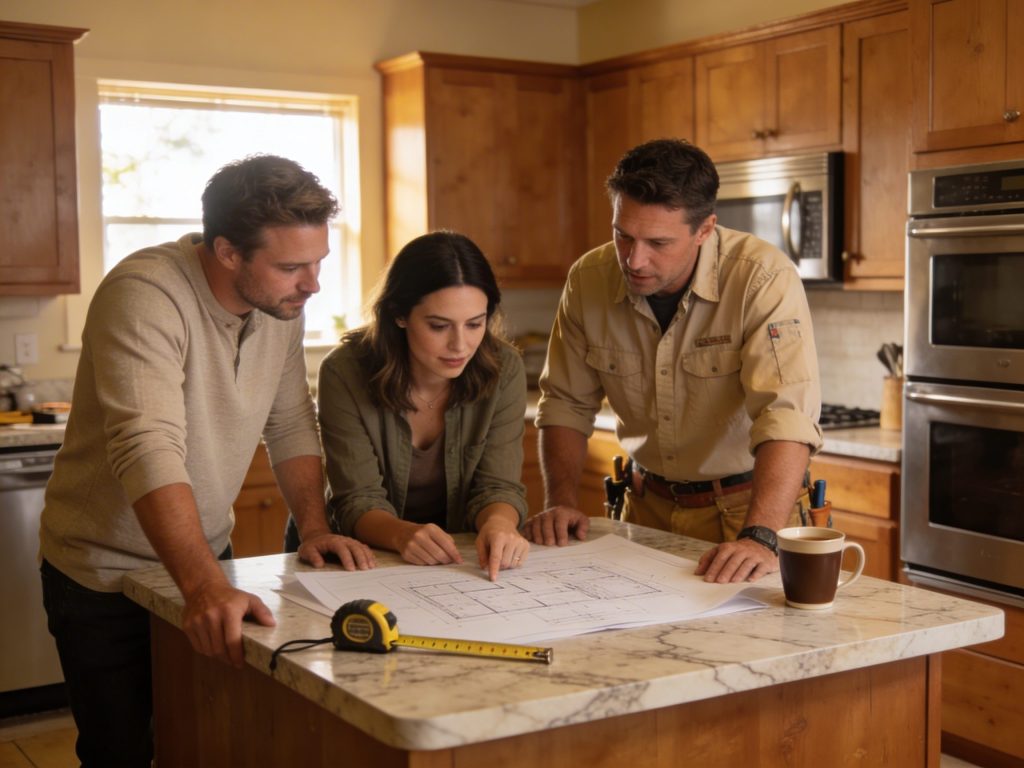
Your home is probably the biggest investment you will ever make. And if you live in the Rio Grande Valley, your home takes a beating that most of the country does not have to deal with. Six months of 90 degree plus heat, humidity that hovers above 70%, expansive clay soil that shifts under your slab, and hurricane season from June through November. All of that adds up. The good news? 2026 is shaping up to be one of the best years in recent memory to tackle a home improvement project down here. Interest rates have come down from their 2023 peaks, the RGV is currently sitting in a buyer’s market with a median sale price around $251,000 in the McAllen area, and material costs on things like lumber and concrete have stabilized after years of wild swings. If you have been putting off upgrades, this is the year to stop waiting. Here are 10 home improvement projects that make real sense for Valley homeowners right now.
1. Why Should You Upgrade Your Insulation First?
This one does not get the attention it deserves, but it is hands down one of the smartest home improvement projects you can do in the RGV. When your AC is running nonstop and your electric bill is climbing past $300 a month in the summer, most people assume the unit is dying. Nine times out of ten, it is not the AC. It is the insulation. A lot of Valley homes, especially those built in the 1990s and early 2000s, have attic insulation that has settled and compressed over the decades. What used to be R 30 is now barely R 13. Adding blown in insulation to your attic typically runs $1,500 to $3,000 for an average Valley home, and you can see your cooling costs drop by 15 to 25% almost immediately. The federal Energy Efficient Home Improvement Credit still lets you claim 30% of qualifying insulation costs, up to $1,200 per year. That is real money back in your pocket. Start here before you spend $8,000 on a new AC unit you might not even need.
2. How Much Does a Kitchen Refresh Actually Cost in the Valley?
Kitchens sell houses. That is true everywhere, but especially down here where the kitchen is the center of family life. Here is the deal: you do not need to gut the whole room to make a massive difference. A minor kitchen update, meaning cabinet refacing, new countertops, updated appliances, a backsplash, and better lighting, typically runs $15,000 to $27,000 and returns anywhere from 72 to 96 cents on every dollar you spend, according to the latest Cost vs. Value data. That is one of the highest ROIs of any home improvement project, period. Cabinet refacing alone usually costs $4,000 to $9,000 depending on kitchen size, and it completely changes how the room looks and feels without the mess and expense of ripping out the existing boxes. Pair that with quartz countertops at $3,000 to $5,000 installed and you have a kitchen that looks like it belongs in a new build. In 2026, lighter countertops and neutral finishes are what buyers want. Stainless steel appliances still dominate. Keep it clean, keep it functional, and you will get your money back.
3. Is a Metal Roof Worth the Investment in South Texas?
Here is where a lot of Valley homeowners get surprised. Yes, a metal roof costs more upfront than asphalt shingles. You are looking at roughly $6.50 to $14 per square foot installed for metal versus $3.50 to $5.50 for standard architectural shingles. For a typical 2,000 square foot Valley home, that means a metal roof might run $13,000 to $28,000 compared to $7,000 to $11,000 for shingles.
But here is what most people do not think about. Asphalt shingles last 15 to 20 years down here, and that is being generous given our heat and UV exposure. A properly installed metal roof lasts 40 to 50 years or more. Metal reflects solar heat and can reduce your cooling costs by 10 to 25%. Many insurance companies offer premium discounts for metal roofs, especially in hurricane and hail zones. And when the next big storm rolls through, you are not going to be the one calling every roofer from Harlingen to Mission trying to get on their schedule. If you plan on staying in your home for more than five or six years, metal is the smarter play. The math works out in your favor every time.
4. What Does a Bathroom Remodel Return in the RGV?
Bathrooms are the second most requested upgrade by buyers, right behind kitchens. And here is why they are such a smart home improvement move: the total investment is lower than a kitchen, but the ROI is almost as strong. A midrange bathroom remodel nationally runs about $25,000 and returns roughly 74 to 80% of the cost at resale, according to the 2025 Cost vs. Value Report.
In the Valley, your costs are going to be lower than the national average because our labor rates run $35 to $50 per hour for skilled trades, compared to $60 to $75 in coastal metros. A solid bathroom update down here, including a new vanity with countertop, updated tile work, modern fixtures, new lighting, and fresh paint, can come in between $8,000 and $20,000 depending on the scope. The key is keeping the existing layout. The moment you start moving plumbing, your costs jump $3,000 to $10,000. Focus on what people see and touch: the vanity, the tile, the fixtures. That is where the visual impact lives.
5. Should You Replace Your Windows Before Summer Hits?
If your home still has the original single pane windows or even older double pane units that have lost their seal (you will notice fog or condensation between the glass), you are losing money every single month on cooling. In the Valley, where your AC runs six months straight, energy efficient windows are not just a comfort upgrade. They are a financial decision. Replacing windows in a typical Valley home costs between $8,000 and $15,000 depending on how many windows you have and the quality you choose. Look for low E coated, double pane windows with a good Solar Heat Gain Coefficient (that is basically how much heat the glass blocks from the sun, and a lower number means less heat gets through).
The federal tax credit for qualifying windows is available up to $600 per year, which helps offset the upfront cost. Window replacement returns about 70 to 75% at resale, but the real savings come from your monthly electric bill. I have seen homeowners cut their summer cooling costs by 20 to 30% after upgrading their windows. That adds up fast when your electric bill used to be $400 a month.
6. How Does Concrete Coating Protect Your Home in Valley Heat?
This one catches people off guard, but it is incredibly practical for the RGV. Your driveway, patio, and garage floor take a beating from our heat. Concrete expands and contracts with temperature swings, and the UV exposure down here fades and deteriorates uncoated surfaces fast. A polyurea or epoxy concrete coating protects against cracking, staining, and wear while giving your surfaces a clean, finished look.
For a two car garage floor, you are looking at $1,500 to $3,000 for a professional application. A driveway coating runs $3 to $7 per square foot depending on the condition of the existing concrete and the product used. This is one of those home improvement projects that is relatively affordable, takes one to two days, and immediately improves your curb appeal. It also makes cleanup a breeze, which matters when you are dealing with Valley dust and mud season. If you are planning to sell within the next few years, a coated garage floor and driveway make your home look well maintained, which signals to buyers that the rest of the house has been taken care of too.
7. Why Is Foundation Maintenance So Important in the Rio Grande Valley?
If you own a home in the Valley, there is a good chance you have already noticed a crack in your slab, your walls, or both. Do not panic, but do not ignore it either. The Valley sits on expansive clay soil, which swells when it gets wet and shrinks when it dries out. That constant movement puts stress on your foundation. The good news is that the most effective thing you can do costs almost nothing: water your foundation.
Keeping a soaker hose around the perimeter of your home and running it for 15 to 20 minutes every other day during dry stretches keeps the soil moisture consistent, which reduces the expansion and contraction cycle. If you are already seeing signs of damage like doors that stick, cracks wider than a quarter inch, or uneven floors, you might need pier work. Foundation repair in South Texas typically runs $4,000 to $12,000 depending on how many piers are needed. A structural engineer’s inspection costs $300 to $500 and is worth every penny before you spend money on repairs. Spending a little on prevention now can save you five figures later.
8. What Outdoor Living Upgrades Add the Most Value?
In the Valley, outdoor living is not a luxury. It is how people actually use their homes for about eight months of the year. A covered patio or pergola with a ceiling fan turns your backyard into an extension of your living space. A basic covered patio addition runs $3,000 to $8,000. Add an outdoor kitchen or grilling station and you are in the $5,000 to $15,000 range.
The ROI on outdoor living projects depends heavily on your neighborhood, but in a market like the RGV where homes in the $200,000 to $300,000 range are the most competitive segment, a well done outdoor space can easily add $10,000 to $20,000 in perceived value. The key down here is shade and airflow. Nobody wants to sit on a concrete pad in direct sun when it is 100 degrees. Build the shade structure first, then add the finishes. That approach gets the most use and the best return on your home improvement investment.
9. Should You Upgrade to a Smart Thermostat and Energy Efficient HVAC?
Your HVAC system is the single biggest energy consumer in your home, and in the Valley, it works harder and longer than almost anywhere else in the country. If your system is more than 10 years old, it is almost certainly running at a lower efficiency than what is available today. A new high efficiency HVAC system costs $5,000 to $12,000 installed in the RGV, depending on the size of your home and the SEER rating you choose. Higher SEER ratings mean better efficiency, and for our climate, you want at least a 16 SEER system, though 18 to 20 SEER units are becoming more common as prices come down.
Pair that with a smart thermostat ($150 to $300 installed) and you are looking at meaningful monthly savings. Smart thermostats learn your schedule and adjust automatically, which prevents the biggest energy waste: cooling an empty house all day. Some utility companies in Texas offer rebates on high efficiency systems, and the federal tax credit for qualifying heat pumps and HVAC equipment can reach up to $2,000. This is one of those home improvement projects where the upfront cost is significant but the monthly savings start immediately and compound over years.
10. How Can Fresh Paint and Curb Appeal Projects Stretch a Small Budget?
Not every home improvement project has to be a five figure commitment. Sometimes the smartest move is the simplest one. A full exterior paint job on a typical Valley home runs $3,000 to $6,000 and immediately changes how your home looks from the street. Use a paint rated for UV and humidity resistance because standard exterior paint fades fast in our sun. Sherwin Williams and Benjamin Moore both make formulas designed for hot, humid climates. Beyond paint, simple landscaping work like cleaning up beds, adding drought tolerant plants, and refreshing mulch can cost $500 to $2,000 and dramatically boost curb appeal.
Updating your front door ($200 to $500 for paint or $1,000 to $2,500 for a new steel entry door) has one of the highest ROIs of any single home improvement project. A new garage door runs $1,500 to $4,000 installed and consistently returns over 90% of the cost at resale. For homeowners on a tight budget, these small projects stack up. You do not have to do everything at once. Pick two or three of these, knock them out over a weekend or two, and your home will look and feel completely different.
Why Is 2026 the Right Year to Invest in Your Rio Grande Valley Home?
So why now? Because the conditions are lining up in a way that does not happen every year. Material costs on lumber and concrete have stabilized after the wild fluctuations of 2021 through 2024. Interest rates on home equity lines of credit have come down from their peaks and currently sit around 8.5 to 9.5%, which is still not cheap but significantly better than where they were in 2023 and 2024. The RGV housing market is in a buyer’s market right now, which means if you are staying put, improving your home is the smartest way to build equity without competing against rising prices. And if you are thinking about selling in the next couple of years, the data is clear: homes that look well maintained and move in ready sell faster and for more money than those that need work.
You do not need to tackle all 10 of these projects. Start with the one that solves your biggest problem, whether that is a sky high electric bill, a cracked foundation, or a kitchen that has not been updated since 2005. Get three written estimates, verify that your contractor is licensed through the Texas Department of Licensing and Regulation (you can look up any contractor’s license for free on their website), and make sure everything is in writing before work starts. That is it. Do those things and you are already ahead of most homeowners down here. The Valley is growing, property values are climbing, and every smart home improvement you make this year is money working in your favor. Everything else builds from there.
